
3-day Self Guided Motorcycle Tour to Pelion
3-day self-guided motorcycle tour to Pelion region in central Greece. 840 km. Includes 2 nights accommodation, motorcycle rental with luggage equipment, GPS navigation with pre-loaded routes, and insurance with excess. Extension days offered as optional. Flexible departure dates. Advanced difficulty. Prices from €590 per rider
This page presents the tour broken down in the following sections:
Pelion in Three Days
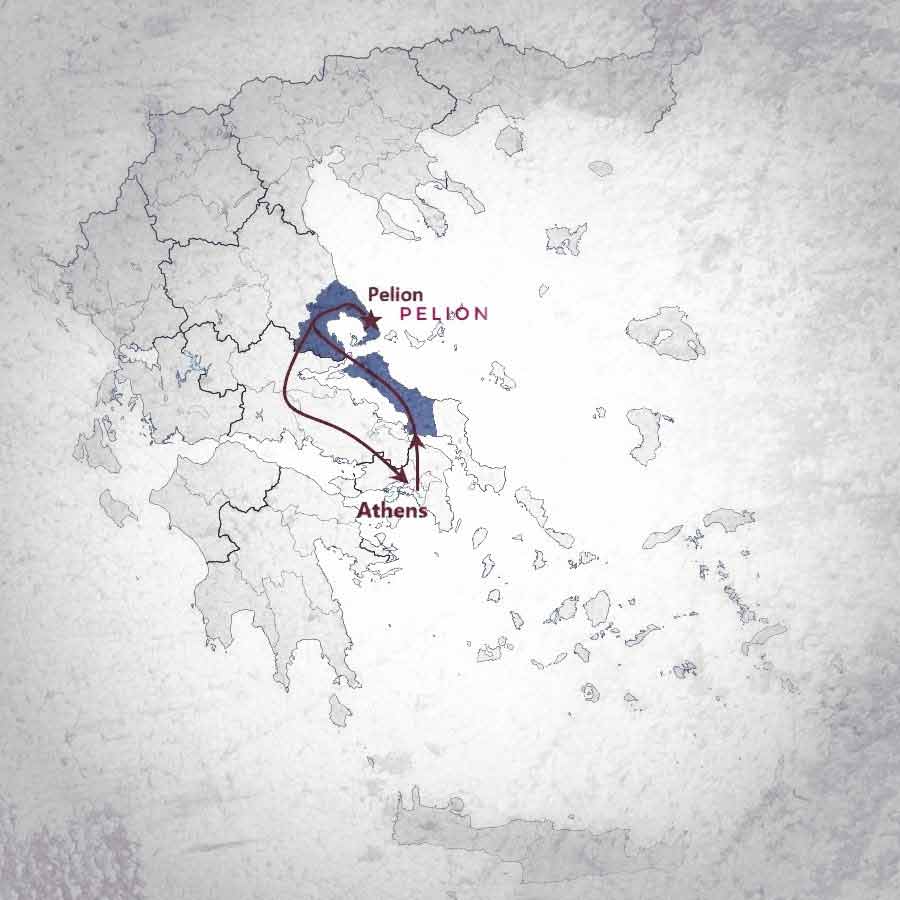
This 3-day tour focuses exclusively on the Pelion Peninsula – a densely forested mountain region 300 kilometers northeast of Athens. Where our 11-day Central & Northwest + Pelion tour uses Pelion as the opening section before progressing to the Pindus ranges, this route concentrates in Pelion itself.
The tour structure is straightforward: Day 1 transits from Athens to Pelion (300km including ferry crossing), Day 2 rides the core mountain loop (110km of continuous technical riding), Day 3 returns to Athens with two route options (direct 350km or extended mountain route 410km).
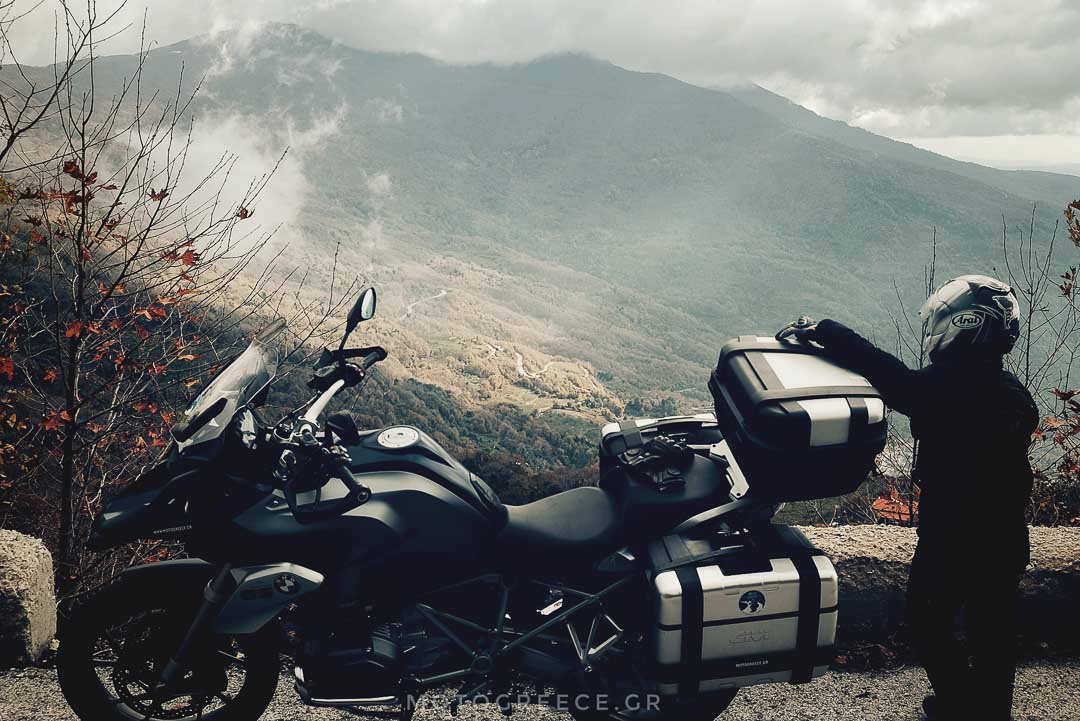
Pelion’s roads are technically demanding from the moment you enter the region – no orientation days, no gradual progression. The mountain loop on Day 2 involves continuous cornering through forest corridors on narrow roads (originally mule paths, later paved) with constant elevation changes. If you’re looking for a weekend getaway that tests mountain riding skills this route provides that experience.
This is the shortest duration tour in our portfolio. The 3-day timeframe means design compromises: long transit days (Day 1 and Day 3), limited time for non-riding exploration, and immediate technical demands without warm-up sections. The trade-off allows riders with limited time availability to experience Pelion’s distinct mountain character without committing to longer multi-region tours.
Who This Tour Suits:
Riders with only 3 days available
- Those wanting to experience Pelion specifically before deciding on longer tours
- Advanced riders comfortable with immediate technical demands
- Riders seeking a challenging getaway within reasonable distance from Athens
Pelion differs from Greece’s other mountain regions (Zagoria, Tzoumerka, Peloponnese) in specific ways: denser forest coverage limiting visibility, tighter road corridors and continuous cornering with minimal straight sections. If these characteristics appeal to you, this concentrated 3-day experience provides access without the broader geographic scope of our longer tours.
Extension options are available:
add one day on the returning leg of the tour, in Delphi. The route does not change from what is described in Day 3 of the itinerary. It is split in two, with the overnight in Delphi allowing you to visit the cultural site on the departure day and to manage the tour’s distance more comfortably.
add one non-riding day in Pelion that will allow you to explore Portaria and relax.
This Tour at a Glance:
Start & Finish : Athens, Greece
Duration: 3 or 4 riding days (extension option)
Riding hours: Daily average: 4-6 hours on the saddle.
Distance: 840-890 kilometers (~ 525 to 555 miles)
Accommodation: Mostly 4 star, elegant boutique hotels. All of them top rated and personally selected by us
Roads: 100% paved. A large amount of this tour runs on narrow, single lane, secondary mountain routes.
Difficulty: Advanced. See section below for better understanding
TYPE OF RIDING
What to Expect on These Routes
Day 1 (Athens – Pelion via Evia, 300km): A long transit day required to reach Pelion from Athens within the 3-day timeframe. The route exits Athens then crosses to Evia island via bridge at Chalkida. The Evia section follows the island’s spine on a popular Greek motorcycle route – two-lane mountain road with moderate curves, good surface quality, regular traffic.
At Evia’s northern tip, a ferry crossing is required (20-25 minutes, departures typically hourly in season). Ferry timing can affect overall day duration – if you miss a departure, add one hour to arrival time. Ferry booking is not pre-arranged; you pay on arrival at the port.
After the ferry, the route approaches Volos then immediately climbs into Pelion mountains. The character change is abrupt – from coastal plains to dense forest mountain riding within 15 minutes of leaving Volos.
Total Day 1 riding time: 5-6 hours including ferry crossing. This is purely transit riding designed to position you in Pelion for tomorrow’s loop. Arrival is typically late afternoon with minimal time for exploration.
Day 2 (Pelion Mountain Loop, 110km): The core riding day – and the most technically demanding. The 110km distance is deliberately short because Pelion’s roads require sustained concentration across the entire loop.
You’ll ride through continuous forest on narrow roads (village-scale width, not tourist infrastructure) with constant radius changes. There are essentially no straight sections – you’ll corner for hours without break. Visibility is limited by dense vegetation (beech, chestnut, plane trees) – you rarely see more than 2-3 corners ahead.
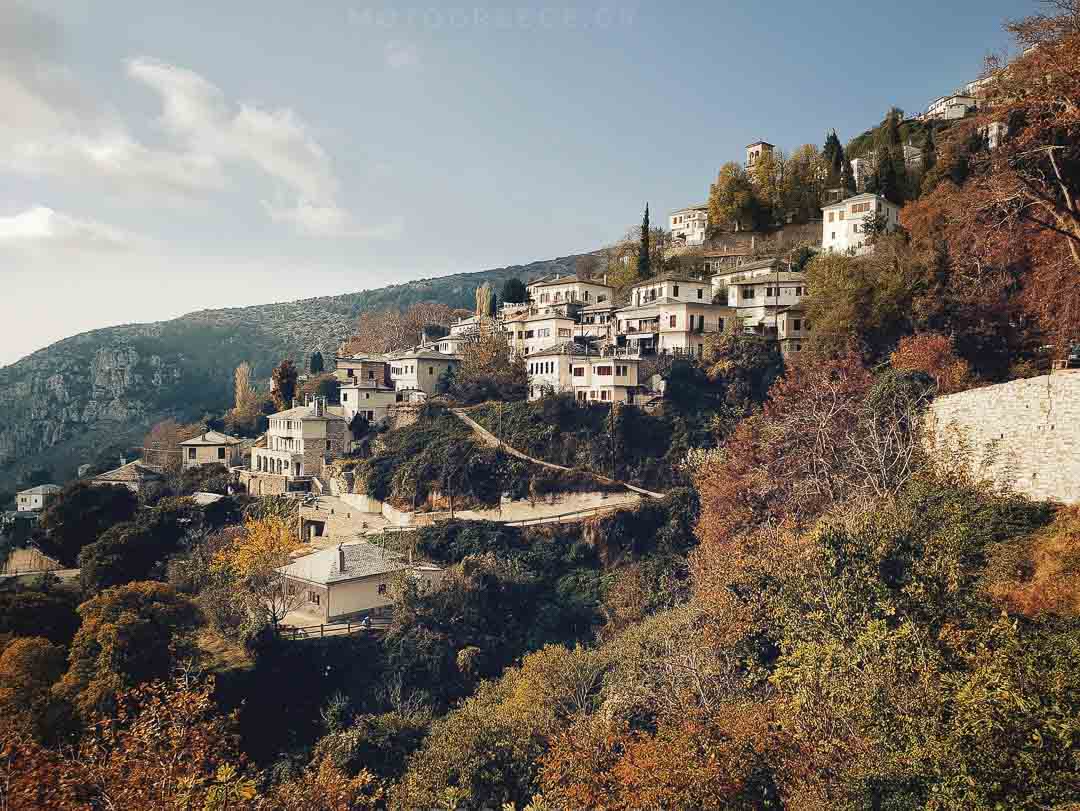
The loop connects multiple mountain villages (Makrinitsa, Vizitsa, Milies, Tsagarada, and others) built at 400-800 meters elevation. On the roads between villages expect limited shoulder width, tight radius turns, and frequent altitude changes over short distances.
Road surfaces are generally good asphalt on primary routes, though secondary village approaches may have narrower widths and tighter corners. Occasional loose gravel appears from cliff drainage – normal for mountain forest roads.
Plan 4-5 hours of riding time for the 110km loop. Speed is limited by road geometry, not legal restrictions – these roads don’t accommodate high speeds even if you wanted them. The continuous technical demands explain the short distance design: longer would be exhausting rather than enjoyable.
The riding character differs from Greece’s other mountain regions:
- vs. Peloponnese mountains: Denser vegetation, narrower roads, different landscape rhythm
- vs. Zagoria: More confined (forest vs. open alpine), tighter corners, more humidity
- vs. Tzoumerka: Less steep gradients but more continuous cornering demands
HIGHLIGHTS OF THIS TOUR
This tour concentrates on Pelion Peninsula’s mountain territory. Athens serves as start/end point, and Delphi is an optional pass-through on Day 3 (not recommended as a stop due to time constraints).
Portaria village (base accommodation for two nights): Traditional settlement at 600m elevation on Pelion’s western slopes overlooking Volos and the Pagasetic Gulf. The village has boutique hotels in restored stone/wood mansions and small tavernas. Located on the approach to higher Pelion villages, making it a strategic base for the Day 2 loop.
Day 2 Loop villages: The route connects approximately 10-12 traditional settlements built at 400-800m elevation across Pelion’s slopes. Three notable examples:
- Makrinitsa: Most tourist-developed village with the largest visitor infrastructure. Traditional architecture, main plateia (square) with views, multiple tavernas and shops.
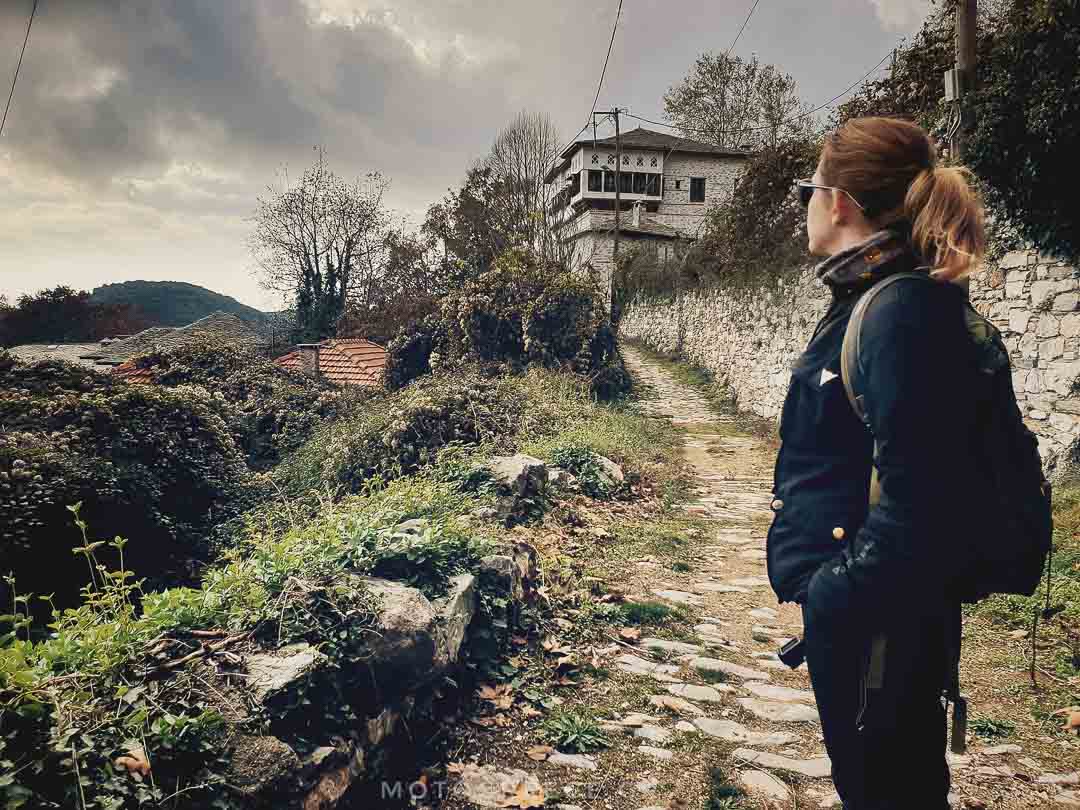
- Vizitsa: Less developed, more authentic village character. Stone pathways, restored mansions, quieter atmosphere. Better for walking exploration away from tourist crowds.
- Milies: Historic village with notable architecture, old train station (narrow gauge railway once connected Pelion villages to Volos), traditional workshops. Mix of tourist infrastructure and local life.
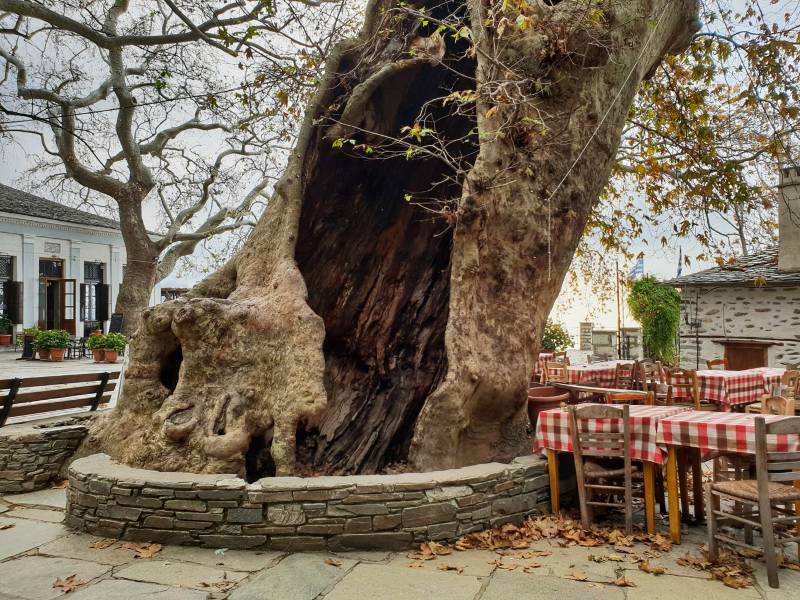
- Tsagarada: Larger village complex on Pelion’s eastern slopes with access to beaches below. Known for enormous plane trees (some over 1,000 years old) in the village squares. The descent to beaches involves steep, narrow roads – factor additional time if planning beach stops.
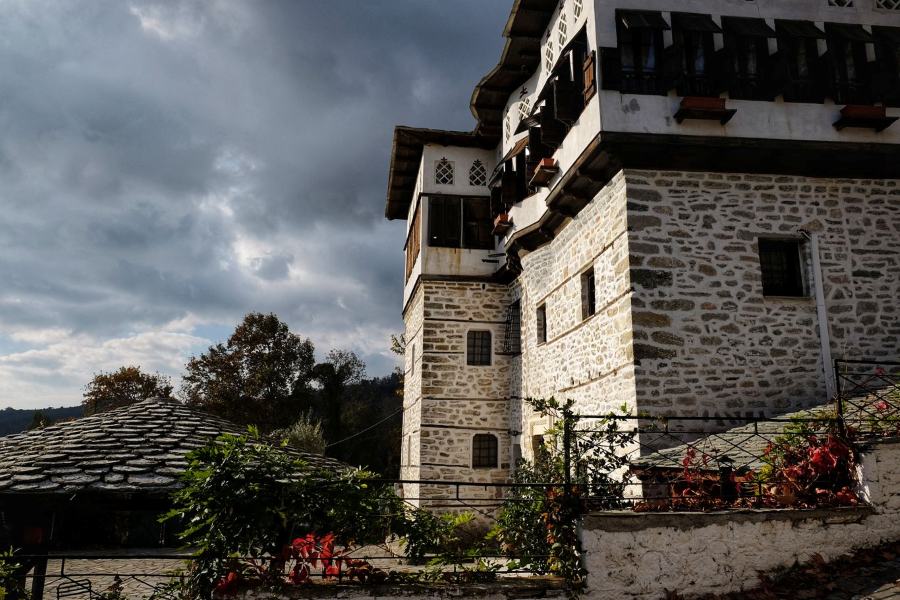
Pelion Architecture & Character: Villages feature distinct regional building style: large stone-and-timber mansions with slate roofs, projecting upper floors (sahnisia), elaborate interior woodwork. Many 18th-19th century mansions are now renovated as boutique hotels or guesthouses. Cobblestone streets and pathways connect houses – villages are built for pedestrian movement, not vehicle traffic.
The region is densely forested (beech, chestnut, oak, plane trees) with high humidity compared to Greece’s drier mountain regions. This creates lush landscape but also limited distant views – you’re riding through forest corridors rather than across exposed alpine terrain.
Eastern Pelion Beaches (Optional Day 2): Several villages on Pelion’s eastern slopes have beach access below via steep descent roads. If weather and time allow, beach stops are possible during the Day 2 loop. However, reaching beaches adds significant time (15 minutes descent/ascent each way) and interrupts the loop’s riding rhythm. Most riders prioritize the mountain riding over beach stops given the limited Day 2 timeframe.
Day 3 Optional – Delphi (Not Recommended): If choosing the extended Day 3 route option, you’ll pass through Delphi (UNESCO World Heritage Site) on the return to Athens. However, we don’t recommend stopping for site exploration. The extended route already requires 6.5 hours riding time; adding 2-3 hours for Delphi makes Day 3 extremely long (9+ hours total including site visit).
If you want to visit Delphi properly, consider adding one extra day. In this 3-day Pelion tour, Delphi is a pass-through location, not a planned stop.
What This Tour Excludes:
- No multi-region progression (exclusively Pelion)
- No Zagoria, Tzoumerka, or other Pindus mountain ranges
- No UNESCO site visits with adequate time allocation
Regional Positioning: This is Pelion only – the same region that forms Days 1-2 of our 11-day Central & Northwest + Pelion tour. If you’re considering that longer tour and want to experience Pelion’s character first, this 3-day concentrated version allows testing the region before committing to 11 days. Conversely, if you complete this tour and want to experience Greece’s other mountain regions (Zagoria, Tzoumerka), the 10-day Central & Northwest tour provides that without repeating Pelion.
The 3-day timeframe serves riders with limited time availability or those specifically interested in Pelion’s forested mountain riding character without broader geographic exploration.
ITINERARY
Day 1: Athens – Portaria (2 nights in Portaria) (300 kilometers / 188 miles)
A long transit day required to reach Pelion from Athens within the 3-day timeframe. Expect 5-6 hours total time including ferry crossing.
Exit Athens via established routes toward Chalkida (approximately 80km on motorway). Chalkida is connected to mainland by bridge – this is your entry point to Evia island.
Once on Evia, the route follows the island’s spine northward. This is a popular Greek motorcycle route – two-lane road through countryside and hilly terrain, with curves, good surface quality, and regular but not heavy traffic. The riding is enjoyable but not technically extreme – use this section to warm up before reaching Pelion’s more demanding roads.
At Evia’s northern tip (near Agiokampos), a ferry crosses to the mainland. Ferry schedule is typically hourly during tourist season, with reduced frequency in shoulder months. The crossing takes 20-25 minutes. There’s no pre-booking system – you pay on arrival at the port and board the next available departure. If you arrive just after a ferry departs, factor one hour waiting time.
After the ferry, the route continues toward Volos (city of ~140,000 population at Pelion’s base). Volos has full urban infrastructure – this is your last opportunity for comprehensive services (large supermarkets, pharmacies, ATMs) before entering Pelion’s mountain villages.
From Volos, the route immediately climbs into Pelion mountains. The transition is abrupt – within 10 minutes of leaving Volos, you’re on narrow roads with numerous switchbacks heading toward mountain villages. The first village you’ll reach is Portaria (your accommodation base).
Portaria sits at 600m elevation on Pelion’s western slopes with views across the Pagasetic Gulf. The village has boutique hotels in restored traditional buildings (stone and wood construction, slate roofs). Properties are typically 8-15 rooms, often family-run. Greek hospitality standards apply.
Arrival is typically late afternoon after 5-6 hours of riding. The long transit day leaves limited time for village exploration on arrival – save that for tomorrow when you’re based in the same location for a second night.
You’ll stay in Portaria for two nights (tonight and after tomorrow’s loop ride), eliminating packing/unpacking and allowing you to use the village as your Pelion base
Day 2: Portaria – Pelion loop – Portaria (110 kilometers / 69 miles)
A loop day returning to the same accommodation. The 110km distance is deliberately short – plan for 4-5 hours of riding time due to continuous technical demands.
This is the core Pelion experience: you’ll ride through dense forest on narrow roads connecting multiple mountain villages. There are essentially no straight sections across the entire loop – you’ll corner constantly for hours. The riding is confined: limited visibility beyond 2-3 corners ahead due to forest density, narrow road corridors and frequent elevation changes.
The loop connects approximately 10-12 traditional villages built at 400-800m elevation. Each village features Pelion’s distinct regional architecture: large stone-and-timber mansions with slate roofs, cobblestone streets, village squares (plateia) with enormous plane trees.
Suggested Village Stops:
If you want to explore beyond just riding through, consider stopping at 2-3 villages maximum. More stops interrupt riding rhythm and extend an already full day. Three notable options:
- Vizitsa: Less tourist-developed, more authentic village character. Stone pathways wind through the settlement connecting restored mansions. Quieter atmosphere than Makrinitsa. Plan 30-45 minutes for walking exploration if you stop here.
- Milies: Historic village with notable architecture and an old narrow-gauge railway station (the railway once connected Pelion villages to Volos). Traditional workshops and kafeneion (coffee houses) maintain local character. Mix of tourist infrastructure and daily village life.
- Makrinitsa: Most tourist-developed village on Pelion. Located on the approach to higher villages with views across the Pagasetic Gulf. Main plateia has multiple tavernas, shops, and tourist facilities. Can be crowded, especially during peak summer months and weekends. Still worth visiting for the architecture and setting, but expect tourist presence.
Walking in villages requires time – cobblestone streets, steep pathways, irregular surfaces. If you plan to explore interiors (churches, museums, shops), factor 45-60 minutes per village stop. With 4-5 hours of riding time already planned, extensive village exploration makes this a very long day.

Eastern Pelion Beach Option:
The eastern slopes of Pelion have several villages with beach access below. The suggested stop is at Agios Ioannis; this is the nearest to the planned route therefor introducing the least interruption in the mountain loop rhythm. Reaching beaches requires descending steep, narrow roads – typically 15 minutes descent each way, plus time at the beach.
Consider beach stops only if you’re willing to extend Day 2 significantly. Most riders prioritize the continuous mountain riding over beach diversions given the limited Pelion timeframe.
Riding Characteristics:
The continuous cornering demands concentration. Unlike Zagoria’s open alpine terrain where you can see long distances, or Peloponnese mountains with varied landscape rhythm, Pelion keeps you in forest corridors for hours. The riding is technically challenging but doesn’t involve the steep gradients of Tzoumerka or the exposed mountain passes of other Greek ranges.
Speed is limited by road geometry – tight radius turns, limited sight lines, frequent altitude changes. The pleasure is in the sustained technical flow, not in covering distance or building speed.
By the end of this day, you’ll understand Pelion’s distinct character. This is the same loop that forms Day 2 of our 11-day Central & Northwest + Pelion tour – riders doing that longer tour experience this exact section before progressing to the Pindus ranges (Zagoria, Tzoumerka).
Return to Portaria for your second night at the same accommodation.
Day 3: Portaria – Athens (options, from 410 to 350 kilometers / 256 to 220 miles)
The return to Athens with two route options offering significantly different riding experiences and times.
Option A – Direct Return (350km, ~5.5 hours riding time):
The efficient return route using a 50/50 mix of motorway and fast provincial roads through Pthiotis and Boeotia prefectures.
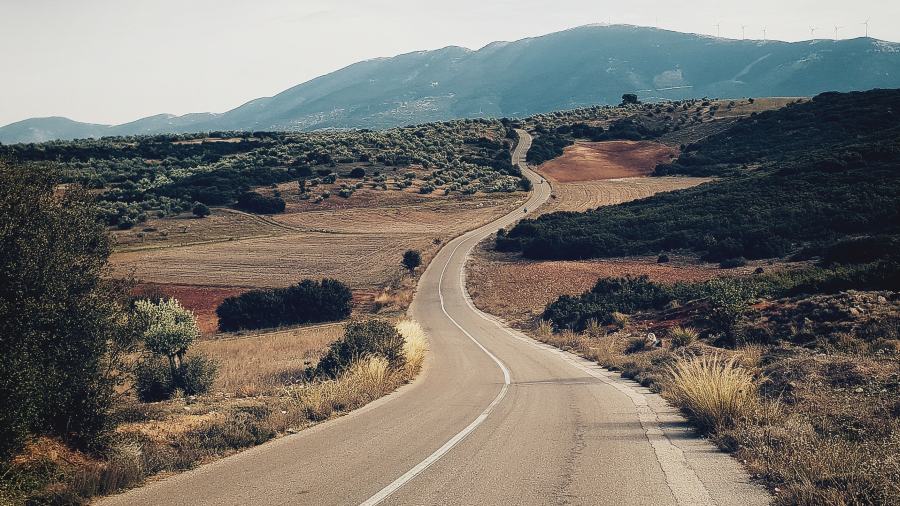
From Portaria, descend to Volos then follow provincial roads southwest through central Greece. These are standard two-lane roads with moderate traffic – not technically demanding, not particularly scenic. The route transitions to motorway for sections where it efficiently covers distance.
This is functional routing designed to complete the Athens return in reasonable time. Choose this option if you need to arrive in Athens by early-to-mid afternoon (typically 3-4pm arrival if departing Portaria by 8-9am), or if you prefer straightforward riding after yesterday’s demanding Pelion loop.
The route passes through agricultural plains and low hills – standard Greek countryside without dramatic landscape features. Traffic increases approaching Athens in the final 40km.
Plan to return motorcycles before 6pm to allow time for inspection and paperwork. If you have same-day evening flights or next-day early departures, the direct route provides appropriate timing buffer.
Option B – Extended Mountain Route via Parnassus (430km, ~6.5 hours riding time):
A more scenic alternative routing west through Phocis prefecture before returning to Athens.
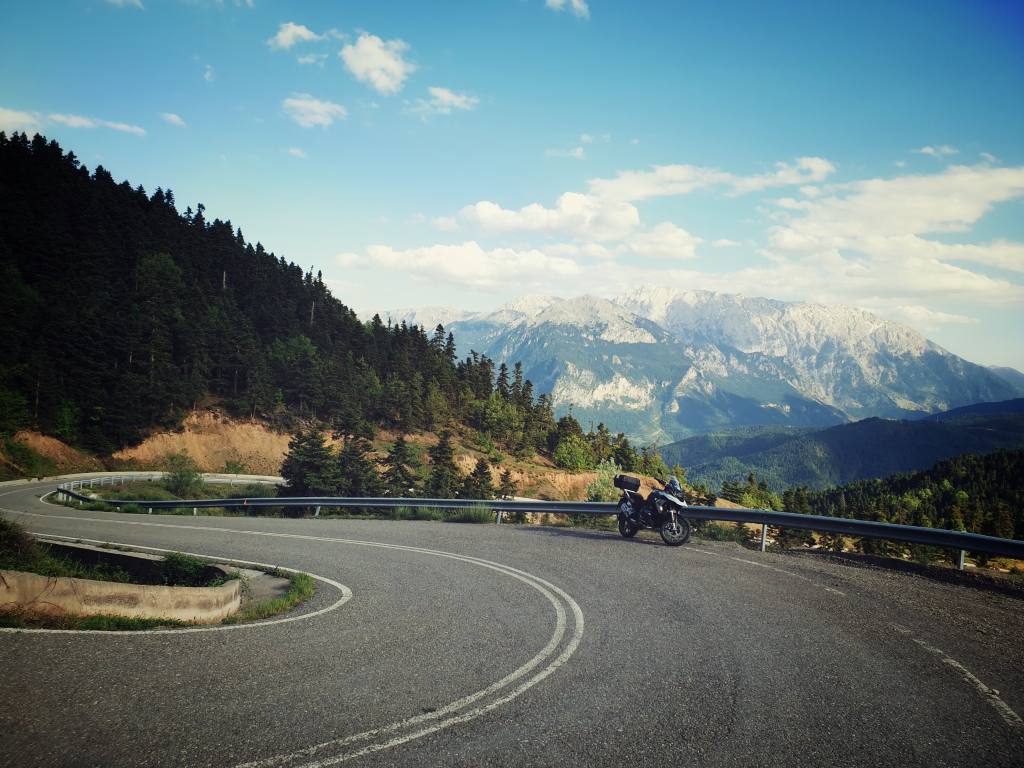
From Portaria, descend to Volos then route southwest toward the western slopes of Mount Parnassus. The route climbs to approximately 1,000m elevation via sweeping mountain curves on good asphalt – enjoyable riding though less technically confined than Pelion’s forest roads. This is open mountain terrain with longer sight lines and wider curves compared to yesterday’s tight cornering.
The route passes through Delphi (UNESCO World Heritage Site). However, we don’t recommend stopping for site exploration. Here’s why: the extended route already requires 6.5 hours riding time. Adding a Delphi visit (2 hours including walking the archaeological site on steep hillside terrain) makes Day 3 extremely long – potentially 9+ hours total.
If you want to visit Delphi properly with adequate time, consider adding one day to the itinerary for this purpose. In this 3-day Pelion tour, stopping at Delphi creates a rushed experience at the site and a very late Athens arrival.
From Delphi/Parnassus, the route turns east toward Athens via provincial roads with good flow and pace through central Greece. The final approach uses Athens ring motorway to bypass urban congestion.
Choose this option only if:
- You have energy remaining after Day 2’s Pelion loop
- You want maximum riding on the final day (preferring scenic routes over efficiency)
- You’re comfortable with longer riding time (6.5+ hours) and later Athens arrival (typically 4-5pm if departing Portaria by 8am)
The extended route adds 60km and approximately 1 hour compared to Option A. If you have same-day evening flights or tight Athens schedules, Option A is the safer choice.
Practical Recommendation:
After two days including yesterday’s demanding Pelion loop, most riders are ready for the direct return (Option A) rather than extending Day 3 with additional mountain riding. The extended option (B) is available for those with energy reserves and preference for maximizing riding over efficient transit.
Plan to return motorcycles before 6pm regardless of route choice. Factor Athens traffic congestion in final approach timing – the ring motorway helps but can still have delays during afternoon hours.
This final day closes the 3-day loop from Athens to Pelion and back, completing the concentrated regional experience within the shortest timeframe in our tour portfolio.
EXTENSIONS OPTIONS
The following two options can be considered, extending the tour from 3 days to 4, or 5 if you choose both.
Option 1: non riding day in Portaria
This will allow you to explore Portaria more in depth, or even engage in other activities. The area features popular hiking trails.
Option 2: add one overnight in Delphi
The original route of day 3 remains unchanged but now is split in 2. This option allows you to:
visit the cultural site of Delphi on the next day, before departure, without feeling time pressure. The remaining distance until Athens is relatively short (185 kilometers).
manage fatigue
DATES
There are no fixed dates for this tour. You may request to do this whenever you wish, provided there is availability of motorcycles and accommodation.
Best experienced during late April, May, early June, then from the 2nd half of September and October.
In November chances of rain are increased..
PRICING
Pricing for the 3-day tour is given in the table below. Prices vary per motorcycle selection and accommodation (solo, sharing room, or 2-up). Booking deposits and payment details are listed after the table.
2026 Prices
| (all prices in euros) | Single Rider, single room | Single Rider, sharing twin room | Rider + Passenger *, double room |
|---|---|---|---|
| BMW R 1300 GS | 1,035 | 890 | 1,115 |
| BMW R 1250 GS | 1,005 | 855 | 1,085 |
| HONDA NT 1100 DCT | 955 | 805 | 1,035 |
| BMW F 800 GS | 885 | 735 | 960 |
| HONDA NC 750X | 790 | 640 | 870 |
| HONDA ΝΧ500 | 740 | 590 | 820 |
(* Rider and Passenger price is for both people, not per person.)
Booking deposit : 200 euros for rider, 100 euros for the pillion passenger.
Balance payment due: the day you collect the bike.
Cost of optional extension days: please contact us.
Note: prices shown are based on quotes from hotels offered to us for group tours on fixed dates. Depending on the exact dates of your travel, prices may be slightly higher. For example (but not restricted to) :
- During the entire month of August
- the “long weekends” around national holidays/anniversaries : 25th March, 28th October, Ash Monday, Greek orthodox Easter, Labour Day (1st of May), Orthodox Holy Spirit Sunday & Monday
INCLUSIONS / EXCLUSIONS
The following are included in the price that you are paying:
- 2 nights accommodation with breakfasts, in personally selected hotels.
- Rental of Motorcycle, with side panniers, top case, comprehensive insurance with excess.
- Rental of 1 GPS per 4 people, with routes and POIs pre-loaded for every day
- Printed map with routes marked and a 15-page handbook with key information for the trip, suggestions, tips etc.
- 2 helmets, of basic quality, European standards approved. Options available to upgrade to high quality helmets, for an added daily fee.
- Free luggage storage at our premises.
- 24% VAT
The following are not included:
- accommodation in Athens, when you fly in and when you ride back to Athens (we can certainly arrange it if you wish)
- airport transfers (offered as an option)
- Fuel & tolls
- Food, drinks, personal daily expenses & tips
- Fines, tickets
- Entrance fees to local museums, tourist sites
- Accommodation & Environmental tax. This is paid directly to each hotel during your check out, and it ranges from 1.5 to 10 euros per night
- Ferries, parking
- Personal travel insurance
Also, not included are the costs of any “added” days you may choose to have. Those costs will typically have to include the daily rental rate of the motorcycle plus the accommodation cost, which varies depending on where you choose to spend those added days.
AVAILABILITY REQUEST AND LINKS TO OUR TERMS
If this tour matches your preferences and your riding experience you can submit an availability request by clicking the button below.
Please read the Tour Terms & Conditions which include our Cancellation Policy.
Check the Frequently Asked Questions.
If you have any questions, don’t hesitate to contact us for further information!
Click here to return to the overview of the self-guided Tours