
Despite a widespread belief, European accident data shows that Greece’s motorcycle risk profile is driven mainly by rider behavior — such as helmet non-use and urban commuting — rather than by uniquely dangerous roads or touring infrastructure.
Are Greek roads dangerous for motorcyclists? The short answer is: the data does not support that claim when context is applied. While Greece does record a high number of motorcycle fatalities compared to some European countries, this is largely explained by human factors — most notably helmet non-use and urban riding behavior — rather than by road infrastructure or rural touring conditions. By examining recent European motorcycle accident data and separating fatal from non-fatal incidents, this article shows why the widespread perception of “dangerous Greek roads” is an incomplete and often misleading conclusion. Here is the full breakdown of what is actually happening on our roads.
The analysis presented here combines data gathered from 26 sources.
Why this matters
For riders considering Greece, perceived road danger is rarely an abstract concern — it directly affects trip planning, expectations, and risk tolerance. Decisions about destination, route choice, riding pace, and even whether to ride at all are often shaped by second-hand claims rather than first-hand data. When those claims are incomplete or misleading, they can distort reality and unfairly frame an entire country’s riding conditions. Clarifying what the data actually shows helps riders make informed decisions based on evidence, not reputation.
1. Introduction: The European Road Safety Landscape and the “Dangerous Roads” Narrative
1.1 The Context of Powered Two-Wheeler Safety in Europe
The safety of Powered Two-Wheelers (PTWs) — a category encompassing motorcycles, mopeds, and scooters — remains one of the most intractable challenges in European transport policy. While the European Union has made significant strides in reducing automobile occupant fatalities over the past two decades, achieving a reduction of approximately 1,000 fewer fatalities in cars between 2019 and 2023, the progress regarding motorcyclists has been markedly slower, with a decrease of fewer than 100 cases in the same period.1
This stagnation highlights a critical divergence in road safety outcomes: cars are becoming safer due to advanced driver-assistance systems (ADAS) and passive structural safety, while motorcyclists remain fundamentally vulnerable, dependent almost entirely on personal protective equipment (PPE) and their own defensive riding behaviors.
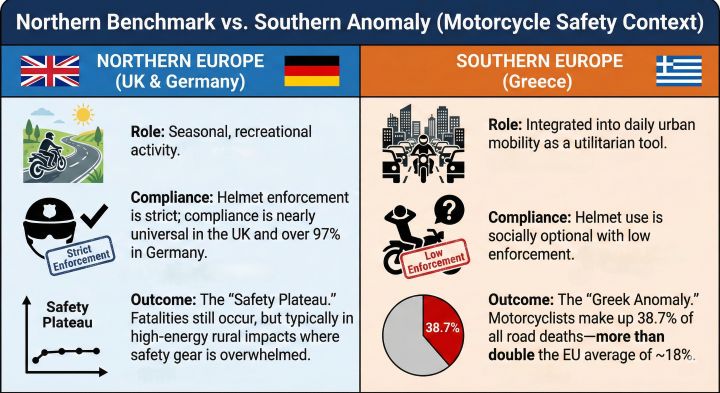
Within this continental context, a distinct geographic and cultural divide exists. Northern European nations, exemplified by the United Kingdom and Germany, typically characterize motorcycling as a seasonal, recreational activity undertaken by older, wealthier riders on high-displacement machines. In contrast, Southern European nations — specifically Italy, Spain, and Greece — integrate PTWs into the very fabric of daily urban mobility. Here, the motorcycle is a utilitarian tool, a solution to chronic congestion, and a year-round mode of transport facilitated by milder climates. This disparity in usage patterns complicates direct statistical comparisons; a “high fatality count” in a country with millions of daily riders may represent a lower risk-per-kilometer than a lower count in a country with sparse ridership.
1.2 The “Greek Anomaly” and the Hypothesis of Behavioral Vulnerability
Greece consistently ranks among the lowest-performing countries in the EU regarding road safety, with 60 road deaths per million inhabitants compared to the EU average of 462. A pervasive narrative, both domestic and international, attributes this grim statistic to the inherent danger of Greek road infrastructure — the belief that “Greek roads are the most dangerous in Europe.” This view posits that poor road geometry, low-friction asphalt, and inadequate signage are the primary drivers of mortality.
However, this report investigates a counter-hypothesis: that the high mortality rate among Greek motorcyclists is less a function of primary risk (the likelihood of crashing due to road conditions) and more a function of secondary risk (the likelihood of dying in a crash due to lack of protection). By analyzing accident data from 2021 to 2024 across six nations, this report aims to debunk the myth of the “dangerous road” as the sole culprit. Instead, it posits that a catastrophic failure in secondary safety compliance — specifically the non-use of helmets — is the variable that transforms survivable accidents into fatal tragedies in Greece.

1.3 Methodology and Data Harmonization
This comparative analysis utilizes cross-sectional accident data from national statistical bodies: the Department for Transport (DfT) in the UK, Destatis in Germany, ONISR in France, DGT in Spain, ISTAT in Italy, and ELSTAT in Greece. To ensure comparability, the analysis focuses on the “Lethality Ratio” — the percentage of reported accidents that result in a fatality. This metric helps normalize for the varying definitions of “serious injury” across jurisdictions (e.g., MAIS3+ medical standards vs. police reports) by isolating the relationship between the event (the crash) and the outcome (survival or death).
The period of study, 2021 through 2024, captures the post-pandemic normalization of traffic patterns. It is crucial to note that 2023 serves as the primary benchmark year for complete verified datasets, while 2024 data relies on provisional figures released by national observatories in early 2025.
2. The Northern European Benchmark: High Compliance and the “Safety Plateau”
To understand the anomaly of Greek accident outcomes, one must first establish a baseline of “best practice” regarding protective equipment. The United Kingdom and Germany serve as this benchmark, representing markets where helmet usage is mandatory, culturally ingrained, and strictly enforced.
2.1 United Kingdom: The Mechanics of Survivability
The United Kingdom presents a mature road safety environment where helmet laws have been enforced since 1973. Compliance is effectively universal (approaching 100%), and the culture of “All The Gear, All The Time” (ATGATT) is prevalent among the recreational riding demographic.
2.1.1 Accident Dynamics and Fatality Trends (2021-2024)
Despite the high level of passive safety, motorcyclists in the UK remain a vulnerable group. In 2023, there were 315 motorcyclist fatalities, a decrease of 10% from the 350 recorded in 20223. However, this reduction must be viewed in the context of persistent serious injuries, which remained high at 5,468.3 Provisional data for 2024 indicates a worrying resurgence, with fatalities estimated to rise by 9% to 343.4.
The critical insight lies in the ratio of fatalities to total casualties. In 2023, the DfT reported 16,756 total motorcyclist casualties (killed, seriously injured, and slightly injured).5
- Total Casualties (2023) : 16,756
- Total Fatalities (2023) : 315
- Lethality Ratio : 1.88%
This ratio of ~1.9% sets a “Northern European Baseline.” It suggests that in a high-compliance environment, a rider involved in a police-reported crash has a roughly 98% chance of survival. The fatalities that do occur are largely driven by high-energy impacts where safety gear is overwhelmed — typically loss of control on rural roads (which account for 67% of fatalities) or high-speed collisions at junctions.6
2.1.2 The Role of Protective Equipment
The DfT data explicitly highlights that head injuries remain a leading cause of death, but the rate of these fatal head injuries is suppressed by universal helmet use. The primary causes of death in the UK are often multiple traumatic injuries to the torso or internal organs from high-speed impacts, rather than the preventable head trauma seen in low-speed urban crashes elsewhere. The 2024 statistics indicate that 92% of killed or seriously injured (KSI) casualties were male, reinforcing the demographic profile of the recreational rider.3
The “Safety Plateau” observed in the UK — where fatalities fluctuate but do not drastically drop — suggests that passive safety (helmets/clothing) has reached its maximum potential. Further reductions would require primary safety interventions (preventing the crash via ABS, better driver awareness), rather than secondary safety improvements.
2.2 Germany: Seasonality and Rural Risk
Germany shares the UK’s profile of high compliance but faces different challenges due to its specific infrastructure (the Autobahn network) and distinct rural road (Landstraße) risks.
2.2.1 Statistical Overview (2023-2024)
According to Destatis, 2023 saw 497 motorcyclist fatalities, a stagnation compared to previous years.7 The number of injuries was substantial, with 25,983 reported injury accidents involving motorcycles.8 Early rolling data for 2024 suggests a slight increase, with 513 fatalities recorded.7
- Total Injuries (2023) : 25,983
- Total Fatalities (2023) : 497
- Lethality Ratio : 1.91%
The alignment between the German (1.91%) and UK (1.88%) lethality ratios is striking. It confirms that in environments with rigorous helmet enforcement and modern medical trauma care, the “floor” for accident lethality is approximately 2 deaths per 100 reported injury crashes.
2.2.2 The Helmet Factor in Germany
German helmet usage rates are consistently above 97% for riders. The Federal Highway Research Institute (BASt) notes that while moped riders occasionally show lower compliance with protective clothing (jackets/gloves), helmet compliance is non-negotiable in the driving culture.9
The analysis of 2023 data reveals that fatalities are heavily concentrated on rural roads, where 58% of deaths occur despite these roads accounting for only 24% of accidents.10 This indicates that in Germany, the “danger” is speed. The helmet prevents death in the city (low lethality), but cannot always prevent death in high-speed rural run-off-road scenarios. This contrasts sharply with the Greek data, as we will see, where urban fatalities remain high.
3. The Southern European Context: High Exposure and the Urban Commute
Moving south, the role of the motorcycle changes from a weekend hobby to a daily utility. Italy, Spain, and France represent high-volume markets where exposure is significantly higher, yet safety outcomes vary based on enforcement and infrastructure.
3.1 France: The Struggle with Vulnerable Road Users
France occupies a middle ground, with high helmet compliance but a massive, diverse fleet of two-wheelers including a high volume of scooters in metropolitan areas like Paris and Marseille.
3.1.1 2023-2024 Accident Dynamics
The ONISR reports that in 2023, 707 motorcyclists were killed, a decrease of 11 from the previous year.11 However, provisional 2024 data indicates a reversal, with fatalities rising to 726.12
- Serious Injuries (2024) : Estimated at ~5,100.12
- Total Injuries (2023) : ONISR estimates total injuries using the “Rhône Register” method, limiting direct comparison with police-only data. However, police-reported injury accidents involving PTWs remain in the tens of thousands.
- Lethality Ratio : Historically, France hovers around a 2.0% – 2.2% lethality ratio for PTW accidents, slightly higher than the UK/Germany but comparable.
3.1.2 Legislative Interventions
France has aggressively targeted secondary safety. Beyond the helmet mandate (which has high compliance), France introduced mandatory glove usage in 2016 to reduce debilitating hand injuries. The 2023 report highlights that while fatalities decreased slightly, the severity of injuries is the focus. The government is now pushing for airbag vests, acknowledging that helmets have done their job and the next frontier in survivability is torso protection.11 This focus on “survivability” underscores a system where basic protection (helmets) is assumed, and policy targets “plus-one” safety measures.
3.2 Italy: The Volume Giant
Italy has the largest parc of powered two-wheelers in Europe. The sheer density of scooters in cities like Rome, Naples, and Milan creates a unique safety landscape.
3.2.1 Statistical Overview (2023-2024)
ISTAT data for 2023 records 734 motorcyclist fatalities, a 6.0% improvement over 2022.13 However, preliminary 2024 data shows a sharp spike, with fatalities rising by 13.1% in the first half of the year.14
- Total Accidents (2023) : 166,525 (all modes).
- Total Injuries (2023) : 224,634 (all modes).
- PTW Fatality Share : Motorcyclists represent 24.2% of all road deaths.15
3.2.2 The Helmet Usage Divide
While national helmet compliance is high, Italy historically faces a North-South divide in enforcement. However, recent years have seen aggressive policing of helmet laws, including the confiscation of vehicles for non-compliance (fermo amministrativo). The lethality ratio in Italy is roughly consistent with France, suggesting that while the number of accidents is huge (due to exposure), the outcome per accident is generally controlled by widespread helmet use. The 2023 drop in fatalities was partly attributed to better enforcement of helmet laws and speed controls.13
3.3 Spain: The Urban Safety Paradox
Spain has been a European leader in reducing road deaths, but the post-pandemic period has seen a deterioration in motorcycle safety metrics.
3.3.1 The 2023 Spike
In 2023, Spain recorded 455 motorcycle fatalities, the highest figure in a decade and a 13% increase over 2022.16
- Urban vs. Interurban : 70% of these deaths occurred on interurban (secondary) roads.16
- Urban Safety : On urban roads, fatalities fell by 6% in 2024 to 286 deaths.17
- Hospitalizations : 38% of all hospitalized traffic victims were motorcyclists.16
3.3.2 Helmet Compliance and Risk
The DGT (Dirección General de Tráfico) notes that in 2024, more than 10% of motorcyclists killed on urban roads were not wearing helmets.18 While 10% is a significant failure rate, it pales in comparison to the Greek statistics. The Spanish data suggests that where helmet compliance fails (that 10%), fatalities occur. However, the majority of deaths (the 70% on interurban roads) are riders who were wearing helmets but died due to high-speed impacts with guardrails or other vehicles. This reaffirms the “Northern” pattern: helmets save you in the city; infrastructure and speed management are needed for the highway.
4. The Greek Anomaly: Deconstructing the Myth
Greece presents a statistical outlier that demands a distinct analytical framework. It ranks 23rd out of 27 EU nations in road safety performance.19 The “myth” suggests that Greek roads are inherently treacherous—poorly surfaced, badly lit, and geometrically dangerous. While infrastructure challenges exist, the data points to a different primary driver of lethality.
4.1 The Fatality and Exposure Reality (2021-2024)
According to the Hellenic Statistical Authority (ELSTAT), the raw numbers for 2023 are alarming:
- Total Road Fatalities : 646.
- PTW Fatalities : 250 (comprising 235 drivers and 15 passengers).20
- PTW Share of Deaths : 38.7% of all road deaths in Greece are motorcyclists.20 This is more than double the EU average of ~18% and significantly higher than Italy (~24%) or France (~22%).
The trend is volatile. After a decade of improvement, 2023 saw a 17.9% increase in PTW fatalities compared to 2022.20 This spike coincides with a return to full tourism and mobility levels, exposing the fragility of the safety system.
4.2 The “Smoking Gun”: Helmet Usage Rates
The most critical differentiator between Greece and its European peers is helmet compliance.
- Observed Usage : The NTUA Road Safety Observatory reports that helmet usage in Greece is approximately 80% for drivers and drops precipitously to 60–65% for passengers.21 In rural areas and on islands (Crete, Rhodes, Corfu), anecdotal and observational evidence suggests rates can fall below 50% during summer months.
- Self-Reported Non-Compliance : The ESRA3 survey (2023) is damning. 42% of Greek motorcyclists admitted to riding without a helmet at least once in the past 30 days. This is the highest self-reported non-compliance rate in Europe.23 For comparison, the rate in Luxembourg is 7.1%.
- The Fatality Correlation : The consequence of this behavior is direct and measurable. In 2023, data indicates that 69% of deceased motorcyclists in Greece were not wearing a helmet at the time of the crash.24

4.3 The Lethality Ratio: Greece vs. The Benchmark
To debunk the “Dangerous Roads” myth, we must compare the Lethality Ratio (Fatalities / Injury Accidents). If the roads were the primary killer, we would expect a high crash rate. If the lack of protection is the killer, we would expect a high death-per-crash rate.
Table 1: Comparative Lethality Ratios (Motorcycles, 2023)
| Metric | United Kingdom | Germany | Greece |
|---|---|---|---|
| Total Fatalities | 315 | 497 | 250 |
| Total Reported Injuries | ~16,400 | ~26,000 | ~4,000 (Estimated)* |
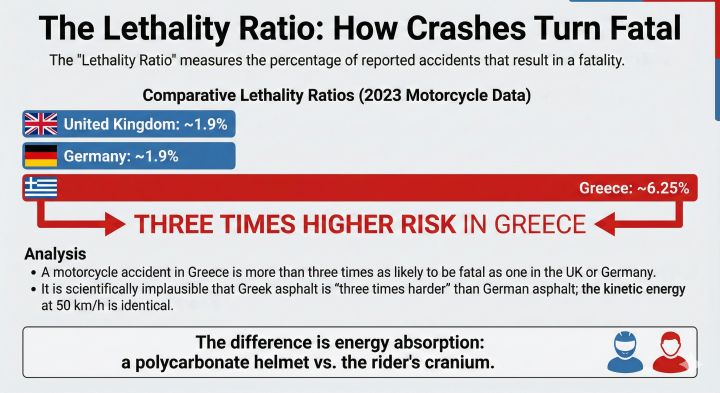
| Lethality Ratio | ~1,9% | ~1,9% | ~6,25% |
*Note: Greek injury data for PTWs specifically is inferred from the total injury pool of 10,553 based on the 38% fatality share and accident involvement rates.
Analysis: A motorcycle accident in Greece is more than three times as likely to be fatal as one in the UK or Germany. It is scientifically implausible that Greek asphalt is “three times harder” than German asphalt. The kinetic energy of a crash at 50 km/h is identical in Athens and Berlin. The difference lies in how that energy is absorbed. In Berlin, it is absorbed by a polycarbonate helmet and armored jacket. In Athens, for 69% of victims, it is absorbed directly by the cranium and body.
4.4 The “Behavioral Multiplier” Effect
The lack of helmets acts as a force multiplier for lethality. Medical research cited in the background material establishes that helmets reduce the risk of death by approximately 42% and severe head injury by 69%.25
Theoretical Adjustment: If we apply this medical efficacy to the Greek data:
- Current Fatalities (2023) : 250
- Unhelmeted Fatalities (69%) : ~172
- Lives potentially saved by helmets (42% of 172) : ~72 lives.
- Adjusted Fatalities : ~178.
If Greece achieved 100% helmet compliance, the PTW fatality count would drop to roughly 178. This would reduce the PTW share of total deaths from 38.7% to roughly 27%, bringing it much closer to the Italian (24%) and French (22%) averages. The “excess” death rate in Greece is therefore not a product of the road, but a product of the rider’s decision (or the state’s failure to enforce that decision).
4.5 Urban vs. Rural: The Pattern of Neglect
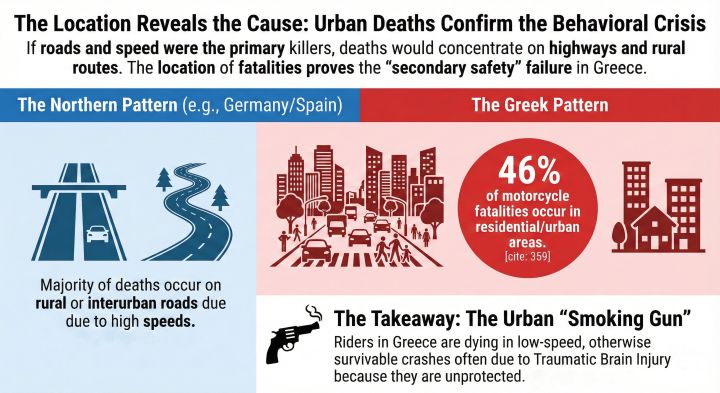
Further evidence against the “Dangerous Roads” myth is the location of fatalities. In Spain and Germany, the vast majority of deaths occur on rural roads due to high speeds. In Greece, 46% of PTW fatalities occur in residential/urban areas.20
Urban accidents are typically lower speed. In a car-vs-bike collision at 40 km/h, a helmeted rider usually survives with bruises or fractures. An unhelmeted rider often dies from Traumatic Brain Injury (TBI). The high prevalence of urban fatalities in Greece is a “smoking gun” for secondary safety failure. It indicates that riders are dying in survivable, low-speed crashes simply because they are unprotected.
5. Comparative Synthesis and Second-Order Insights
Synthesizing the data across the six nations reveals deeper themes regarding culture, enforcement, and infrastructure.
5.1 The Exposure Myth
One might argue that Greece has more deaths simply because it has more motorcycles. Greece does indeed have the highest ownership rate: roughly 160 motorcycles per 1,000 inhabitants, compared to the EU average of 67.24
However, Italy also has massive ownership and dense urban riding but maintains a lower lethality ratio. The difference is the culture of compliance. In Northern Italy, helmet use is socially enforced; in Greece, it is socially optional. The high exposure in Greece should prompt a more robust safety system (stricter enforcement), yet the inverse is true—the ubiquity of bikes has led to a laissez-faire attitude towards their regulation.
5.2 Infrastructure: A Contributor, Not the Cause
This report does not absolve Greek infrastructure. Greek roads often suffer from lower friction coefficients (polished asphalt) and poor guardrail protection compared to Germany. However, if infrastructure were the primary killer, we would expect car fatality rates to be equally disproportionate.
- Greek Car Fatality Share : ~26% of total deaths.
- EU Average Car Fatality Share : ~44%.
The fact that car occupants (who are protected by the vehicle shell regardless of infrastructure) make up a smaller share of deaths in Greece than the EU average suggests that the roads themselves are not creating a uniform “death trap.” The extreme risk is specific to the unprotected user.
5.3 The Enforcement Vacuum
The data suggests a correlation between enforcement rigor and survival.
- UK/Germany: High enforcement -> High Compliance -> Low Lethality.
- Spain/France: Moderate/High Enforcement -> High Compliance -> Moderate Lethality.
- Greece: Low Enforcement -> Low Compliance -> High Lethality.
The Greek data notes a legislative paralysis: the Road Traffic Code has not been substantially updated since 2007, and a culture of police “leniency” (returning confiscated licenses as “favors”) undermines the perceived risk of getting caught.19
6. Conclusion and Recommendations
The investigation into motorcycle accident data across Europe (2021–2024) provides a clear refutation of the belief that Greek roads are uniquely “dangerous” in a way that inevitably leads to death. While Greek infrastructure presents challenges, the extraordinary fatality rate among motorcyclists is, largely, a self-inflicted crisis of secondary safety.
Key Findings :
- Lethality is the Key Indicator: A motorcycle crash in Greece is roughly three times more likely to result in death than in the UK or Germany. This discrepancy cannot be explained by road quality alone.
- The Helmet Correlation is Absolute: With 69% of fatalities involving unhelmeted riders—and a national self-reported non-compliance rate of 42%—the lack of head protection is the single most significant variable.
- Urban Deaths confirm the Hypothesis: The high volume of fatalities in low-speed urban environments proves that riders are dying in accidents that should be survivable.
- Behavior Trumps Engineering: While engineering improvements are needed, they are long-term and costly. The immediate solution is behavioral.
Final Assessment:
The myth that “Greek roads are the most dangerous” is a convenient deflection. It externalizes the blame to inanimate asphalt and geometry. The reality revealed by the data is that Greek riding culture is the most dangerous. The road environment is unforgiving, but it is the rider’s failure to wear a helmet—facilitated by lax enforcement—that seals their fate.
Strategic Recommendation:
For Greek policy makers, the data offers a clear roadmap. Investment in road resurfacing, while necessary, will yield diminishing returns for motorcycle safety if the Lethality Ratio remains at 6%. The immediate priority must be a “Zero Tolerance” enforcement campaign on helmet usage, modeled after the successes in Italy and Spain. Reducing the non-compliance rate from 42% to the EU average of <10% would likely save more lives in 24 months than a decade of infrastructure projects. The “danger” of the Greek road is real, but it can be neutralized by the simple click of a chin strap.
About the author:
This guide was written by John Kapelakis, co-founder of MotoGreece.
Last updated: January 2026
Works cited
- EU road fatalities drop by 3% in 2024, but progress remains slow – Mobility and Transport, accessed January 7, 2026, https://transport.ec.europa.eu/news-events/news/eu-road-fatalities-drop-3-2024-progress-remains-slow-2025-03-18_en
- Greece’s Deadly Roads: 100 Die in Traffic Accidents in Three Months – The National Herald, accessed January 7, 2026, https://www.thenationalherald.com/greeces-deadly-roads-100-die-in-traffic-accidents-in-three-months/
- Reported road casualties Great Britain: motorcyclist factsheet 2024 – GOV.UK, accessed January 7, 2026, https://www.gov.uk/government/statistics/reported-road-casualties-great-britain-motorcyclist-factsheet-2024/reported-road-casualties-great-britain-motorcyclist-factsheet-2024
- Data shows slight rise in road deaths in 2024, accessed January 7, 2026, https://roadsafetygb.org.uk/news/data-shows-slight-rise-in-road-deaths-in-2024/
- Reported road casualties Great Britain, provisional results: 2023 – GOV.UK, accessed January 7, 2026, https://www.gov.uk/government/statistics/reported-road-casualties-great-britain-provisional-results-2023/reported-road-casualties-great-britain-provisional-results-2023
- Reported road casualties Great Britain: motorcyclist factsheet 2023 – GOV.UK, accessed January 7, 2026, https://www.gov.uk/government/statistics/reported-road-casualties-great-britain-motorcyclist-factsheet-2023/reported-road-casualties-great-britain-motorcyclist-factsheet-2023
- Persons killed in traffic accidents by type of traffic participation – Statistisches Bundesamt, accessed January 7, 2026, https://www.destatis.de/EN/Themes/Society-Environment/Traffic-Accidents/Tables/persons-killed-traffic-participation.html
- Persons injured in traffic accidents by type of traffic participation – Statistisches Bundesamt, accessed January 7, 2026, https://www.destatis.de/EN/Themes/Society-Environment/Traffic-Accidents/Tables/persons-injured-traffic-participation.html
- Comparing Riders’ Experiences in Real Life Crashes with and without Airbag Jackets – Institut für Zweiradsicherheit (PDF), accessed January 7, 2026, https://www.ifz.de/wordpress/wp-content/uploads/2024/11/07_Winkelbauer_final-paper.pdf
- A timeline of road traffic fatalities – DataPulse Research, accessed January 7, 2026, https://www.datapulse.de/en/a-timeline-of-road-traffic-fatalities/
- La mortalité routière en légère baisse en 2023 – La Gazette France, accessed January 7, 2026, https://www.lagazettefrance.fr/article/la-mortalite-routiere-en-legere-baisse-en-2023
- More Motorcyclists and Pedestrians Killed in France Despite Safety Measures – Roadpol, accessed January 7, 2026, https://roadpol.eu/?p=1586
- Road accidents 2023 – Istat, accessed January 7, 2026, https://www.istat.it/en/press-release/road-accidents-2023/
- Report-road-accidents-2024.pdf – ACI Gov (PDF), accessed January 7, 2026, https://aci.gov.it/app/uploads/2025/07/Report-road-accidents-2024.pdf
- INCIDENTI STRADALI Anno 2023 | Istat (PDF), accessed January 7, 2026, https://www.istat.it/wp-content/uploads/2024/07/Versione-testuale-infografica-Incidenti-Stradali-2023.pdf
- LAS PRINCIPALES CIFRAS DE LA SINIESTRALIDAD VIAL EN ESPAÑA 2023 – DGT, (PDF), accessed January 7, 2026, https://www.dgt.es/export/sites/web-DGT/.galleries/downloads/dgt-en-cifras/publicaciones/Principales_Cifras_Siniestralidad/Informe-Anual-2023-Principales-Cifras_V18_FINAL_ES_acd_np_md_mqt_OK_20250130.pdf
- Urban Road Deaths in Spain Fell 6 % in 2024 | N332.es, accessed January 7, 2026, https://n332.es/urban-road-deaths-in-spain-fell-6-in-2024/
- Spain’s traffic authority warns of eight ‘dangerous’ mistakes on a motorbike that could cost you your life | Sur in English, accessed January 7, 2026, https://www.surinenglish.com/spain/spains-traffic-authority-warns-eight-dangerous-mistakes-20251027141954-nt.html
- Road safety performance in Greece – George Yannis Blog, accessed January 7, 2026, https://www.georgeyannis.com/road-safety-performance-in-greece/
- ROAD TRAFFIC ACCIDENTS: Year 2023, accessed January 7, 2026, https://www.statistics.gr/documents/20181/e1a1c3f2-2bfe-09fb-6a16-97fe8637ce31
- Safety Performance Indicator (SPI) – Protective equipment, (PDF), accessed January 7, 2026, https://road-safety.transport.ec.europa.eu/document/download/36a13f8f-4e5c-41d1-9cd2-7a1b4b1ef6e5_en?filename=ERSO-SPI-Protection.pdf
- Country Profile – Greece – ROAD SAFETY – European Union, (PDF), accessed January 7, 2026, https://road-safety.transport.ec.europa.eu/document/download/84102944-04ff-4908-9aed-897b70f99bd3_en?filename=erso-country-overview-2024-greece.pdf
- Thematic Report – Road safety protective equipment – European Union, (PDF), accessed January 7, 2026, https://road-safety.transport.ec.europa.eu/document/download/3f836856-1adf-47d5-9ec4-f7aa1645a9c4_en?filename=ERSO-TR-Protective_Equipment-20240610.pdf
- New Legislation in Greece Aims to Enforce Helmet Use for Motorcyclists, accessed January 7, 2026, https://www.thenationalherald.com/no-helmet-no-fuel-for-motorcyclists-at-greek-filling-stations/
- A statistical analysis of motorcycle helmet wearing in … – nrso.ntua, (PDF), accessed January 7, 2026, https://www.nrso.ntua.gr/geyannis/wp-content/uploads/geyannis-pj56m.pdf
- Fatalities from non-use of seat belts and helmets in Greece: a nationwide appraisal. Hellenic Road Traffic Police – PubMed, accessed January 7, 2026, https://pubmed.ncbi.nlm.nih.gov/9542548/